
Reviewed · CORFU OLD TOWN WALKS & HISTORY
Corfu: History and Culture Walking Tour
Corfu has layers, and you can walk them. This Corfu Town history and culture walking tour strings together Venetian, French, and British influence in a way that feels practical and easy to follow, right on foot. You start at the Old Fortress and finish in the heart of civic Corfu, with stops that explain how different rulers shaped everyday life and local tradition.
Two things I like a lot: the focus on real places (not just dates), and the way the guide keeps the story human. Guides such as Nausica, Valia, Alice, and Ariti have a knack for making architecture and power dynamics feel like they connect to the city you’re standing in.
One consideration: it’s not set up for people with mobility impairments. The route includes walking and time on uneven streets around the historic center, so plan accordingly.
In This Review
- Key points worth knowing before you go
- Why Corfu Town works so well on foot
- Starting at Agoniston Politechniou and finding the Old Fortress
- Old Venetian Fortress: the views are only half the story
- Corfu Town lanes and squares: where the story turns into everyday life
- St. Spyridon Church: the architecture stop you’ll remember
- Town Hall Square: Corfu’s former elite neighborhood in plain view
- The walking pace, timing, and what the 3 hours really buys
- Price and value: why $93 feels fair for what’s included
- What to bring (and the one thing you’ll thank yourself for)
- Who should book this tour (and who should skip it)
- Should you book this Corfu history and culture walking tour?
- FAQ
- How long is the Corfu History and Culture Walking Tour?
- What does the tour cost?
- Where do I meet my guide?
- Is the Old Fortress entrance included?
- Is food included in the tour?
- What group size should I expect?
- What language is the tour guide?
- Is the tour suitable for people with mobility impairments?
Key points worth knowing before you go
- Small group (max 8) means more chances to ask questions without shouting over the sea of scooters.
- Old Fortress entrance included and you skip the ticket line, so you lose less time waiting and more time looking.
- St. Spyridon Church stop adds a strong visual anchor with its striking bell tower.
- Town Hall Square context helps you understand why certain neighborhoods mattered more than others.
- Licensed English guide brings the Venetian-French-British blend into sharper focus, with plenty of on-the-ground examples.
Why Corfu Town works so well on foot
Corfu Town is the kind of place where history sticks to the corners. You don’t have to picture an old map and guess where power lived. You can see it in the street shapes, the skyline, and the way big buildings hold their ground while smaller lanes do the weaving.
That’s exactly why a 3-hour walking tour is such a smart format here. In a short window, you get a guided line through the historic center: fortress views, religious architecture, and civic landmarks. It’s also a good choice if you’re balancing port days, beach time, or a jam-packed schedule.
The route is built around a simple idea: empires leave fingerprints, and Corfu has plenty of them. Venetians, French rulers, and the British all affected how the island functioned and how locals carried on. Instead of treating those influences as trivia, the tour helps you read the city like a living document.
Rather wander the alleys? More Corfu old-town walks
- Corfu Town: Guided Walking Tour and Local Food Tastings
★ 4.9 · 313 reviews - Best Corfu Tour with Boat Trip & Old Town for Cruise Passengers
★ 4.5 · 107 reviews - Corfu Old Town Guide Tour with Dog or City with 4 paws
★ 4.5 · 85 reviews - Taste Corfu: Private Corfu Food Walking Tour
★ 5.0 · 82 reviews - Corfu: Gastronomy Walking Tour
★ 4.9 · 78 reviews
Starting at Agoniston Politechniou and finding the Old Fortress
You’ll begin near Agoniston Politechniou, with the practical meeting point right in front of the Old Fortress. Your guide waits by the statue of Schulenburg, which is a big help if you’re arriving with jet-lag and a phone battery that’s giving you attitude.
Meeting at the fortress area also sets the tone. Right from the start, you’re not doing a generic orientation walk. You’re going straight to a defensive structure that tells you, in stone, that this town mattered.
A small-group setup (limited to 8 participants) matters more than people expect. It helps the guide pace the walk, answer questions, and adjust when people slow down for photos or when the light turns good on the walls.
Old Venetian Fortress: the views are only half the story
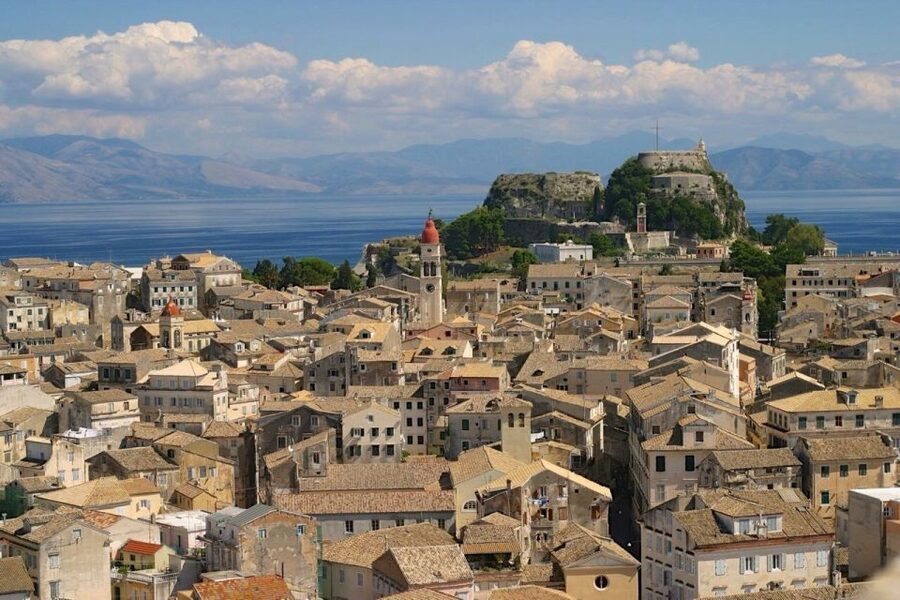
The headline stop is the Old Venetian Fortress, and there’s a practical reason this is the best opening move. You’re anchored in a place that was designed for control—by the Venetians—and you can see how that control shaped the layout of the area around it.
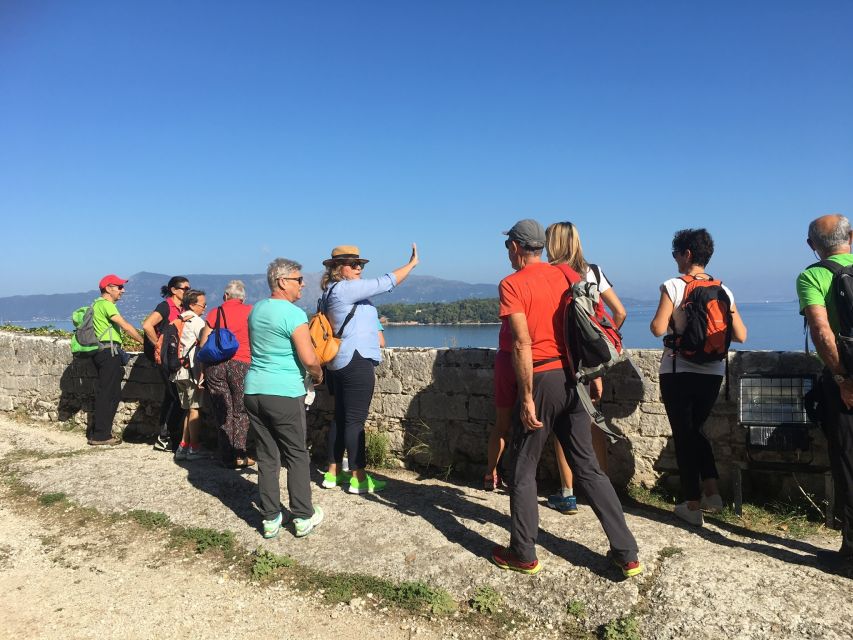
You get a guided visit rather than a quick wander. Expect the guide to point out what you should notice: the fortress character, how the walls relate to the surrounding views, and what Venetian rule changed on the island. The entrance fee is included, and you skip the ticket line, which helps a lot in peak times when queues eat into your limited vacation hours.
The best part of starting here is that it trains your eye. After you’ve seen a fortress built to project power, the later stops make more sense. Town Hall Square isn’t just pretty. St. Spyridon isn’t just a church. Everything starts to connect back to who held influence and what they needed from the people below.
Corfu Town lanes and squares: where the story turns into everyday life
After the fortress, you continue through the historic center on foot, moving from quieter lanes to livelier squares and fountains. This section is where the tour shifts from big structures to street-level culture.
You’ll pass by alleys that feel partly abandoned and then turn into spaces that feel lived-in. That rhythm is useful. It teaches you something important about Corfu: the island isn’t frozen in one era. Layers of use and neglect can both show up within a few turns, and that makes the walking experience feel honest.
This is also where your guide’s style becomes part of the value. Some guides—like those named in standout feedback (Nausica, Valia, Alice, and Ariti)—are especially good at connecting visual details to social life. They tend to explain why certain places were valued, how traditions formed around them, and how new rulers didn’t erase what already existed.
If you like photo moments, this is also where you’ll get them. Think small streets, sudden openings to views, and building facades that look different depending on the angle.
St. Spyridon Church: the architecture stop you’ll remember
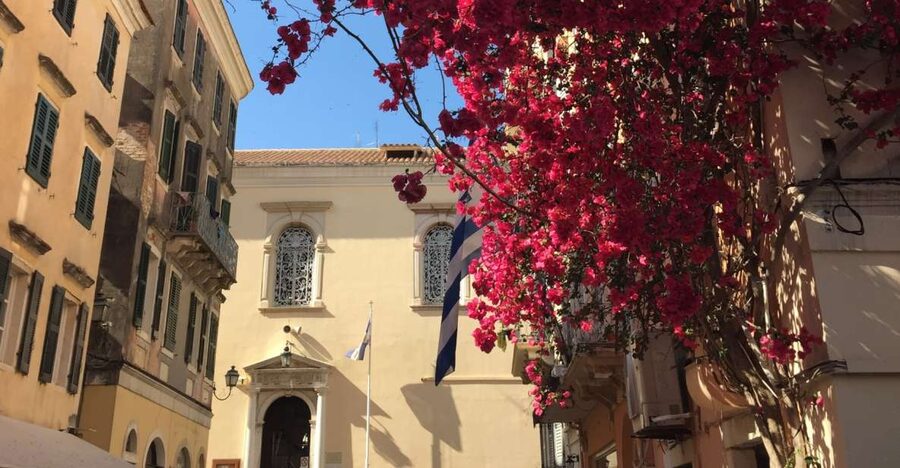
The tour takes you to St. Spyridon Church, described as a 16th-century Greek Orthodox church with a standout bell tower—the highest in the Ionian Islands.
Even if you’re not the type to collect church facts, this stop works because it’s visually clear and historically grounded. You’re not just told that the church matters. You get help noticing what makes it special: the form of the building, the bell tower presence, and the way it anchors the town around it.
This stop also balances the tour’s imperial influences. The Venetians, French, and British left their marks, yes—but religion and local identity are also a major part of how the island kept its own voice. Seeing a prominent Orthodox church right in the middle of the walking route helps you understand how governance and tradition overlapped.
A few more Corfu outings we would happily point a friend towards

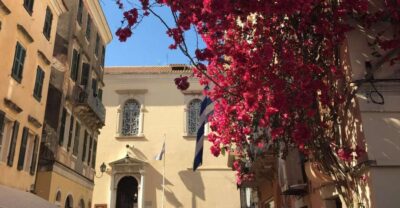


Town Hall Square: Corfu’s former elite neighborhood in plain view
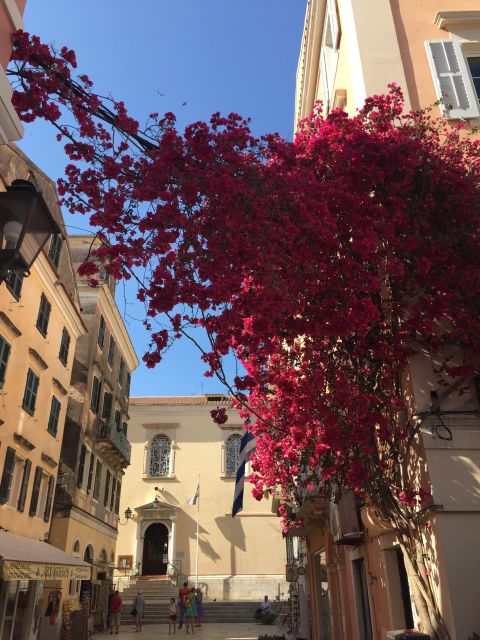
The last leg finishes at Town Hall Square, a location tied to power and privilege. It was once considered Corfu’s most exclusive neighborhood, and the tour uses that idea to explain what elite life looked like and where it happened.
This is where you’ll notice monuments and civic markers. The square helps you shift from architecture-as-style to architecture-as-social structure. It’s easy to walk through a European square and miss what it meant. Here, the guide’s job is to make the meaning land.
If you’re the kind of person who likes to understand who had access and who didn’t, this ending is satisfying. You stop thinking only in terms of buildings and start thinking in terms of public space—where decisions were made, where people gathered, and how status shaped daily movement through the city.
The walking pace, timing, and what the 3 hours really buys
Three hours sounds short. It is short. That’s the point.
You’re looking at a compact circuit that covers:
- the Old Fortress guided visit
- the historic-center stroll to St. Spyridon Church
- the finish at Town Hall Square
Because the group is small, your guide can keep the pace moving without turning it into a power walk. Still, it’s a walking tour in a historic center. Wear shoes you can trust for uneven pavement and long stretches.
If you only have half a day in Corfu Town, this tour is a strong way to get oriented fast. If you’re staying longer, it’s a great foundation tour—you’ll spot things on your own later because you’ve already learned how to read the city.
Price and value: why $93 feels fair for what’s included
At $93 per person for a 3-hour small-group tour, the value comes from the combination of:
- a licensed English-speaking guide
- a guided Old Fortress visit plus the entrance fee included
- a skip-the-ticket-line benefit
- a small group size limited to 8 participants
Most walking tours skimp on one of those elements. Either they cut the guide time, forget the entrance fee, or let group size balloon. Here, the structure is tight: you pay for a guided experience that covers a major landmark and then uses the surrounding streets to explain the bigger story.
Is it a bargain? It’s not a $20 group stroll. But for a fortress visit plus focused storytelling in a small group, it lands in a reasonable spot—especially if you consider how quickly time gets expensive while you’re hunting for tickets or translating on the fly.
What to bring (and the one thing you’ll thank yourself for)
Keep it simple:
- Bring comfortable shoes. You’ll be on your feet.
- Bring water if you tend to get thirsty easily; the tour info doesn’t list food as included, so plan hydration.
- If you’re planning photos, a phone with a charged battery helps—this route gives you plenty of angles from fortress walls and church towers.
The tour lasts about 3 hours, so you don’t need a backpack full of supplies. You just need the basics and footwear you won’t regret.
Who should book this tour (and who should skip it)
This tour is a great fit if you:
- want a guided line through Corfu Town’s most meaningful landmarks
- like history explained through buildings and neighborhoods, not just timelines
- prefer small groups where you can ask questions
- enjoy architecture and want context for what you’re seeing
It’s probably not for you if you have mobility impairments. The route is described as not suitable for that, which usually means uneven streets and limited options to make the walk fully accessible.
Should you book this Corfu history and culture walking tour?
I’d book it if you want a clear, efficient way to understand how Corfu Town became a patchwork of Venetian, French, and British influence—without losing time to logistics. Starting at the Old Fortress, then heading to St. Spyridon Church, then ending at Town Hall Square is a smart route that keeps the story moving.
Skip it if you want a food-focused experience. Food isn’t included here, so if your dream tour includes tastings as a guaranteed part of the ticket, look for a different format. And if walking distances are a challenge, you’ll be happier with an option designed for accessibility.
If you do book, choose comfortable shoes, arrive ready to look up as much as you look ahead, and be ready for the guide to turn what you see into a storyline you can remember.
FAQ
How long is the Corfu History and Culture Walking Tour?
It lasts about 3 hours.
What does the tour cost?
The price is $93 per person.
Where do I meet my guide?
Meet your guide by the statue of Schulenburg in front of the Old Fortress.
Is the Old Fortress entrance included?
Yes. The Old Fortress entrance fee is included, and you can skip the ticket line.
Is food included in the tour?
No. Food is not included.
What group size should I expect?
It’s a small group, limited to 8 participants.
What language is the tour guide?
The tour is guided in English.
Is the tour suitable for people with mobility impairments?
No, it is not suitable for people with mobility impairments.
The Corfu Backstory
- Small-Group Food and Cultural Tour in Corfu
★ 5.0 · 299 reviews - Small-group Corfu Town Historical Walking Tour
★ 5.0 · 39 reviews - Corfu: Historic Buildings and Great Personalities Tour
★ 4.8 · 24 reviews - Tour in Corfu Town: Historic Buildings & Great Personalities
★ 5.0 · 24 reviews - Corfu Town express tour: 90 minutes of History, Culture and Charm
★ 5.0 · 24 reviews
More Tour Reviews in Corfu
- From Corfu Island: Antipaxos & Paxos Blue Caves Boat Cruise
★ 4.6 · 2,963 reviews - From Corfu: Day Cruise to Paxos, Antipaxos, and Blue Caves
★ 4.6 · 2,851 reviews - Full-Day Boat Tour of Paxos Antipaxos Blue Caves from Corfu
★ 4.5 · 1,567 reviews - Corfu: City Sightseeing Hop-On Hop-Off Bus Tour
★ 4.1 · 937 reviews - Day Trip to Saranda and Butrint National Park from Corfu
★ 4.2 · 847 reviews
Corfu Old Town on Foot
- Corfu Town: Guided Walking Tour and Local Food Tastings
★ 4.9 · 313 reviews - Best Corfu Tour with Boat Trip & Old Town for Cruise Passengers
★ 4.5 · 107 reviews - Corfu Old Town Guide Tour with Dog or City with 4 paws
★ 4.5 · 85 reviews - Taste Corfu: Private Corfu Food Walking Tour
★ 5.0 · 82 reviews - Corfu: Gastronomy Walking Tour
★ 4.9 · 78 reviews
Not the one? Have a browse through the rest of what Corfu gets up to






Corfu Old Town Walks & History, compared.
 ★ 4.3Paleokastritsa Beach and Old Town Bus Shore ExcursionFrom $44704 reviews
 ★ 4.9Corfu Town: Guided Walking Tour and Local Food TastingsFrom $104313 reviews
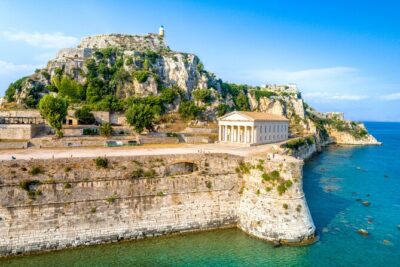 ★ 4.5Best Corfu Tour with Boat Trip & Old Town for Cruise PassengersFrom $72107 reviews
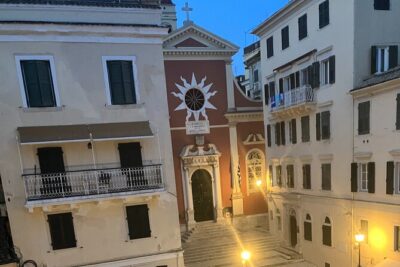 ★ 4.5Corfu Old Town Guide Tour with Dog or City with 4 pawsFrom $3385 reviews
 ★ 5.0Taste Corfu: Private Corfu Food Walking TourFrom $18182 reviews
 ★ 4.9Gastronomy Walking TourFrom $10478 reviews
 ★ 3.5Achilleion Palace and Corfu Old Town TourFrom $5667 reviews
 ★ 3.7Corfu Cruise Port: City Highlights tour & Old Town visitFrom $4162 reviews
Browse the lists this tour appears in